Alibaba's Qwen series features three advanced AI models designed for diverse robotics applications, enhancing language understanding and physical interaction.
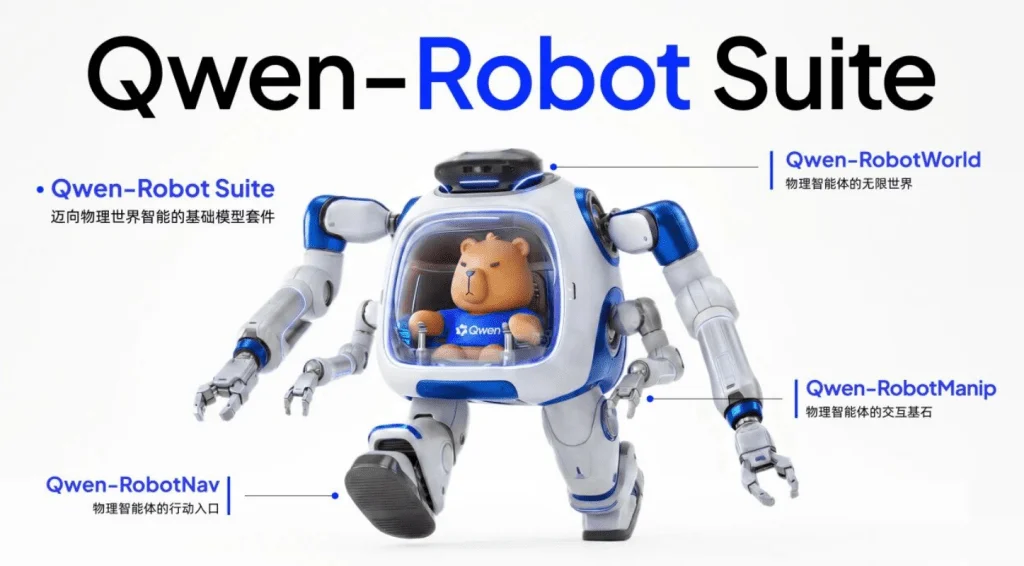
Overview of the Qwen-Robot Series
Alibaba's Qwen team has unveiled a new robotics suite that includes three distinct foundation models: Qwen-RobotNav, Qwen-RobotManip, and Qwen-RobotWorld. These models are designed to integrate language processing with various physical actions, advancing embodied AI capabilities. This development reflects a significant shift in the robotics industry, as companies increasingly seek to blend computational power with physical robotics in more intelligent and responsive systems.
The Impetus Behind Qwen-Robot Deployment
The rise of embodied AI systems like those from Alibaba signifies a broader trend toward making machines not only think but also act in ways that mimic human interaction. Historically, robotics has relied heavily on pre-programmed behaviors, often lacking the adaptability needed for complex environments. The Qwen series tackles this limitation head-on, introducing models that not only process language but also execute tasks that require nuanced responses to real-world stimuli.
Qwen-RobotNav: Driving Mobile Robotics
Focusing on mobile robotics, Qwen-RobotNav enhances vision and language integration through controllable observation encoding and tool-based interfaces. This model consolidates four important tasks—instruction following, goal-directed navigation, target tracking, and autonomous driving—into a cohesive framework. The implications are significant: if you're working in this space, you'll recognize that such multi-tasking capabilities could transform how robots operate in everyday settings, from warehouses to public spaces.
The core functionality of Qwen-RobotNav relies on sophisticated algorithms that interpret visual data in tandem with spoken or written commands. This ability allows the model to navigate dynamic environments, adapting in real time to obstacles and changing contexts. The expectation is that the technology will reduce the time taken for deployment while increasing reliability, which is paramount for industries relying on autonomous robotics.
Qwen-RobotManip: Improving Manipulation Techniques
Qwen-RobotManip achieves standardization in the state-action space by representing end-effector movements as incremental poses within the camera's coordinates. This method allows robots to execute complex tasks with precision—think about delicate manipulation or assembly work that requires a high degree of accuracy. It has been trained on over 38,100 hours of open-source data, allowing for large-scale learning that supports various robotic platforms, thus providing versatile manipulation capabilities.
This enhanced manipulation technique highlights a growing tendency amongst robotic developers to prioritize dexterity alongside raw computational power. The ability to manipulate objects safely and effectively will have profound implications for industries such as manufacturing, healthcare, and logistics—where precision can drive down costs and improve outcomes. One can't help but wonder how this model could reconfigure workflows that rely on human labor today.
Qwen-RobotWorld: A Versatile World Model
Serving as a comprehensive general-purpose model, Qwen-RobotWorld links vision-language understanding with predictions of future states through a natural-language action interface. The ability to forecast physically plausible future scenarios across tasks such as navigation, driving, and manipulation is what truly sets this model apart. This capability demonstrates a model's ability to generalize across a range of embodied AI applications, enhancing its usefulness in complex problem-solving situations.
What’s particularly striking about Qwen-RobotWorld is its potential versatility. Imagine a robot that can process natural language to establish intent, observe its surroundings, and then project possible outcomes based on its actions. This is more significant than it looks: it could potentially lead to advancements in autonomous decision-making systems, where robots are tasked with managing unpredictable environments without constant human oversight. This opens doors to completely new applications in autonomous delivery systems, search and rescue operations, and smart home devices.
Challenges and Considerations
As promising as these models are, there are inherent challenges that need to be addressed. For example, the reliability of AI decision-making in highly dynamic environments can still be a major concern. While the Qwen series leverages vast amounts of data for training, the unpredictability of the real world often leads to unexpected issues that even sophisticated models struggle to handle. Algorithms that excel in simulated settings can falter when faced with real-life conditions, a known drawback that the industry continuously battles.
Another consideration is the ethical implications of deploying such advanced robotics solutions. There’s growing concern over privacy, job displacement, and the potential misuse of AI-powered robotics. If these systems are adopted widely, how will societies adapt? And what safeguards will be in place to ensure responsible use? These are pressing questions that should accompany any discussions regarding the deployment of AI in robotics.
Future Outlook for Robotics and AI Integration
The launch of the Qwen-Robot series signals not just a leap for Alibaba but also a reflection of where the industry is headed. As embodied AI continues to merge with robotics, the boundaries of what’s possible are being pushed. Companies that invest in these technologies have the opportunity to redefine efficiency and creativity in numerous fields.
That said, the road ahead is filled with hurdles. Technological advancements must go hand-in-hand with ethical deliberations to ensure that the benefits of such powerful tools are equitably distributed. The development of standards and regulations will be critical to fostering trust in these technologies.
Ultimately, the Qwen series may well shape the future direction of robotics. However, the tension between innovation and ethical considerations remains. How stakeholders navigate this landscape will determine not just the success of Alibaba’s models, but the evolution of robotics as a whole.
Discussion
Sign in to join the discussion.