This piece discusses the challenges of building chat interfaces in React Native and how to improve performance with streamed LLM responses.
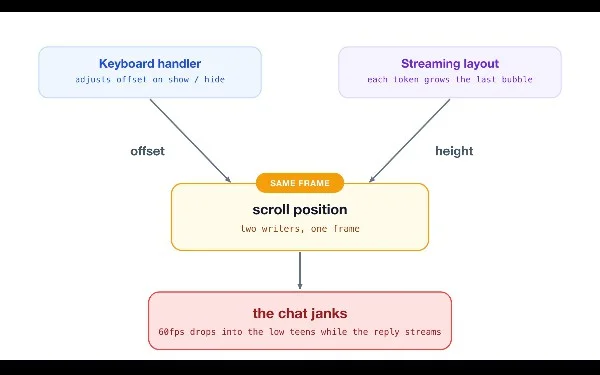
The Challenge of Chat Interfaces
Creating a chat interface might seem straightforward, but in React Native, it often becomes a complex task. Balancing the software keyboard with a dynamic, scrolling list is notoriously tricky, leading many developers to struggle with achieving a smooth user experience. With the growing integration of chat applications in various sectors—from customer service to mental health—it's clear these interfaces must be both functional and intuitive. The challenge arises not just from the technical aspects of coding but also from the design considerations that influence user engagement. This complexity stems from the need to provide a seamless interaction that allows users to communicate easily while accessing the information they need.
What's more, developers have to consider a multitude of devices with varying screen sizes and orientations. The keyboard's appearance can often obscure input fields, disrupting the natural flow of conversation. In many cases, the chat interface needs to adjust in real-time, a feat that demands a well-thought-out architecture. This isn't just a theoretical problem; user frustration stemming from poorly designed interfaces can lead to high dropout rates. If you're working in this space, user retention hinges significantly on these nuances. Hence, the challenge of crafting these interfaces will continue as mobile chat applications proliferate.
Current Solutions Fall Short
As we integrate large language models (LLMs) into various applications, the market still lacks effective, ready-made chat components for React Native. Most existing solutions rely on outdated libraries that come with rigid frameworks or force developers to build interfaces from scratch. This situation creates a frustrating bottleneck for developers who want to innovate rather than reinvent the wheel. The absence of flexible, modular components means many will spend unnecessary time coding and debugging basic functionalities rather than focusing on unique features that could differentiate their products in a crowded market.
Moreover, many current offerings don't adequately address the needs of LLM integration, which is particularly relevant as these models are increasingly becoming the backbone of conversational interfaces. Developers often find themselves patching together disparate libraries that don’t quite fit, leading to a disjointed user experience. Not only does this mean more work upfront, but it can also result in long-term maintenance headaches. Libraries often become obsolete quickly, leaving developers with the burden of continuous updating to keep up with platform changes. What this means for you is that if you're investing in new chat functionalities, a better approach might be to consider building a custom solution or seeking out components specifically designed with modern requirements in mind.
Streaming Responses to Improve Performance
After designing my own solution, I attempted to stream LLM responses token by token. Unfortunately, it resulted in unexpected issues, consuming a week to diagnose the problems that arose. Streaming responses theoretically presents tremendous advantages in delivering more engaging chat interactions. However, the reality has shown that implementing such systems introduces a significant layer of complexity. Achieving real-time data handling without sacrificing the responsiveness of the interface remains crucial for development.
Token streaming presents its own set of challenges, such as ensuring that the interface can accurately reflect changes without overwhelming the user. For example, if responses aren't delivered smoothly, users might experience delays or interruptions that can break the flow of conversation. This is more significant than it looks. Developers must contend with not just technical faults but also user perceptions of speed and efficiency. Frustration with lag can lead to users abandoning the interface entirely. While solutions exist to cache or pre-load information, they often require additional resources, further complicating already complex interactions.
Implications for the Future
This ongoing challenge speaks to a broader trend in the tech industry. As we see an exponential rise in the use of AI and machine learning, there's an urgent need for better tools that enable developers to integrate these technologies easily. With chat interfaces becoming standard across applications, the demand for sophisticated, user-friendly components will only grow. Companies must be aware that investing in better chat solutions isn’t merely a choice; it's quickly becoming a necessity in a competitive market.
The development community is reaching a tipping point where the tools must evolve to better support the needs of developers looking to incorporate advanced language models. As chat interfaces continue to penetrate various sectors, their functionality will directly influence user satisfaction and retention. Ultimately, the best approach may not involve patching up existing frameworks but rather rethinking how chat solutions can be built from the ground up. This shift could inspire a new wave of development standards aimed at optimizing user interactions in a tech landscape increasingly defined by AI capabilities.
Finally, as you consider these issues, remember that the quality of the chat interface can make or break a user's experience. A poorly implemented chat can lead to disengagement, while a well-designed one can enhance interactions to feel more natural and human. The future of chat technology doesn't just hinge on the trouble developers face; it also hinges on how effectively we can streamline their processes to make meaningful user experiences possible.
Discussion
Sign in to join the discussion.