Prompt caching significantly boosts AI performance by minimizing redundant computations, leading to faster responses and lower operational costs.
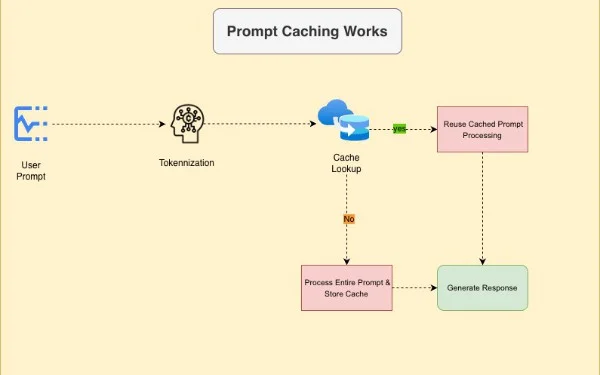
As the integration of Large Language Models (LLMs) into enterprise systems accelerates, the need for improved response times and cost-efficiency has become paramount. Prompt caching stands out as a highly effective strategy to address these challenges. By eliminating the need to repeatedly process identical segments of prompts, this technique allows AI systems to efficiently reuse previously calculated prompt representations. While traditional tokenization focuses on converting text into understandable tokens, prompt caching enhances this process by saving and reusing the results of unchanged token sequences. This leads to quicker inference times, reduced latency, and lower costs associated with API calls, particularly in scenarios involving repetitive prompts or recurring contextual information.
Understanding Prompt Caching
Consider prompt caching to be a "memory shortcut" for AI models. When a prompt is first tokenized, the model engages in a thorough processing of it. However, if the same prompt prefix resurfaces, the model can bypass the complete reprocessing of those tokens, allowing it to fetch the pre-computed results and only handle any new or altered segments in the prompt. This process not only enhances performance but also addresses some of the common inefficiencies associated with AI systems that frequently encounter similar requests.
The Mechanics Behind Prompt Caching
At its core, prompt caching relies on intelligent memory management. Similar systems typically use a hash map to store processed prompts and their corresponding outputs. This essentially means that when an identical or similar prompt is encountered, the AI doesn't start from scratch. Instead, it can pull from this "memory" of previous computations. This setup is particularly beneficial for businesses where specific queries are often repeated. Instead of observing lag times that can hinder user experience, organizations can ensure rapid responses.
Moreover, the storage of these pre-calculated results goes beyond simple retrieval; it spans various attributes of the result set. A well-implemented prompt cache can account for various user contexts, user inputs, and even variations in phrasing that might affect outcomes. In other words, it’s not just about matching text; it’s about recognizing the underlying intent and context, which are often crucial in creating useful AI-driven applications.
Industries Ripe for Prompt Caching
Yet, not all sectors benefit equally from prompt caching. Industries such as e-commerce and customer support stand to gain the most. For instance, in e-commerce, customer queries on products frequently overlap. If a customer asks about product availability, the AI reinforcement can efficiently retrieve previous responses about similar queries. This responsiveness isn’t just a minor improvement; it impacts customer satisfaction directly and can influence purchasing decisions.
Similarly, in customer support, where agents or AI tools often face recurring issues, prompt caching can streamline the response process significantly. Technical support bots encounter identical user problems consistently. When such systems leverage prompt caching, they reduce redundancy in query resolution, which can lead to decreased handle times and ultimately enhance service quality — pivotal in maintaining customer loyalty in a competitive environment.
Cost Implications
From a financial perspective, prompt caching has serious implications. AI systems that rely heavily on API calls can quickly accumulate costs—especially when those calls involve intensive computations for repeated prompts. By reducing the need for constant recalculations, businesses can lower their operational costs while increasing capacity. The more a business can mitigate expenses linked to API usage, the better it can scale operations without significant increases in budget. Saving just a fraction on every call can lead to substantial savings over time, especially for high-volume applications.
In essence, implementing prompt caching can allow organizations to route funds previously allocated to computational costs towards product improvement, customer engagement tactics, or further training of their AI models.
Technical Challenges and Considerations
However, implementing prompt caching is not without its challenges. For one, maintaining the cache can add complexity to the AI's overall architecture. As the volume of stored prompts grows, system performance can degrade if not managed properly. Cache expirations and updates must be effectively handled to ensure that the system does not misfire on generating responses based on outdated data.
Moreover, this approach demands additional development resources. Developers will need to put mechanisms in place to determine when to cache responses and when to invalidate them. Depending on the context, this could mean creating sophisticated logic to discern slight variations in prompts that still warrant different outputs. The nuance here can be substantial and should not be underestimated.
Future Outlook for Prompt Caching in AI
The future of prompt caching appears promising as AI systems become integral to more sectors. As businesses strive for efficiency and operational excellence, the adoption of mechanisms like prompt caching will likely grow. Expect ongoing research and development to enhance caching strategies and protocols. Artificial intelligence is still in its infancy, and new approaches to prompt handling will evolve.
This could lead to more intelligent caching solutions that reduce not just latency, but also learn from user interactions in real time. If you're working in this space, staying abreast of these developments will be crucial. The more adaptive and responsive AI systems can become in managing prompt information, the more they will fulfill their potential to create value at any level of enterprise.
And let’s face it, businesses that refuse to embrace such advancements may risk falling behind as competition escalates.
Discussion
Sign in to join the discussion.