AI systems need more than extended context for long-running tasks; they must manage progress and adapt to changing conditions effectively.
Understanding AI Task Performance
Model capability is accelerating, particularly in regards to prolonged software tasks. According to the February-March 2026 Frontier Risk Report by METR, the Claude Opus 4.6 model can handle simpler tasks for approximately 17.8 hours before its success rate drops to 50%. However, when faced with more complicated scenarios—such as shifting environments, limited resources, or irreversible mistakes—this duration shrinks significantly to just 6.4 hours.
This difference in performance demonstrates more than just a number; it highlights the underlying principles that guide AI functionality. As machine learning models evolve, their ability to handle increasingly complex tasks is often touted as a benchmark for progress. It's easy to assume that longer task durations would reflect stronger capabilities. Yet, this superficial metric does not capture the nuanced reality of AI task management. The Claude Opus 4.6 might excel at maintaining a steady course on straightforward tasks, but when the complexity ratchets up, it falters significantly.
If you're working in this space, you'll know that AI models are not just about processing information; it's also about the contextual understanding that informs decisions in real time. A singular focus on duration can be misleading. The subtleties of task execution—like dynamically adapting to new data or altering strategies based on evolving conditions—can be pivotal. That's where many existing models, including Claude Opus 4.6, struggle. They can handle straightforward inputs well but often lack the deep contextual learning needed for more sophisticated challenges.
Challenges Beyond Task Length
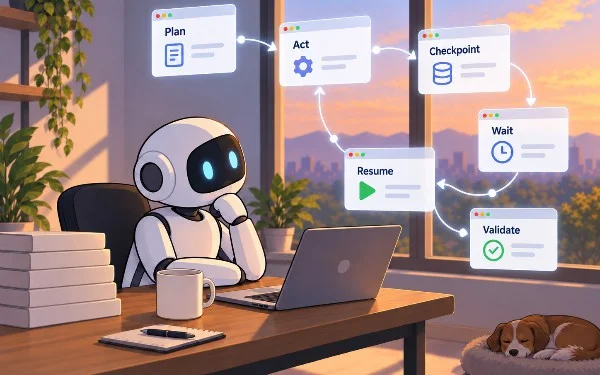
This disparity indicates that sheer task duration isn't the primary hurdle. Designing AI for long durations involves a multifaceted approach where systems must consistently track progress, adapt to evolving conditions, and recoup from erroneous assumptions that disrupt the process. More so, the complexity of tasks can introduce variables that necessitate real-time decision-making and adjustment—something many models are still getting accustomed to.
A glance at the challenges reveals that mere longevity in task execution is insufficient. Consider the dynamics involved in task management for AI systems: they must analyze vast datasets, identify patterns, and respond to unexpected outcomes quickly. This is particularly critical as the pace of change in many sectors accelerates. In real-world applications, for instance, a finance model might need to adjust strategies based on market fluctuations happening at breakneck speed. The mere capability to run for several hours without failing isn't a guarantee of effectiveness in practical applications.
That's where adaptive learning comes into play. Without the ability to adapt and recover from mistakes, AI models risk making decisions that compound errors. A system that's unable to shift its approach after encountering a dataset anomaly or a change in user behavior can quickly derail entire projects. The sooner stakeholders recognize the limits of current AI systems in complex scenarios, the better prepared they will be for the challenges ahead.
The Technical Underpinnings
To fully grasp the implications of AI task performance, one must consider the technical intricacies involved in delivering results. The structure of AI models like Claude Opus 4.6 often includes layers designed specifically for understanding context, which can fail under pressure. Simplistic tasks that require less contextual understanding can usually be navigated relatively easily. But as tasks evolve to include variables like unpredictability or dynamic resource management, these models can quickly become overwhelmed.
The design of AI models often features different components that enable specialized functions. For example, transformer architectures have revolutionized language processing, allowing models to handle larger inputs and generate more refined outputs. However, when it comes to integrating these capabilities into long-running tasks, the architecture may not stack up as needed. In many ways, the discrepancies in performance serve as a reminder of how the AI community must balance advancement with practical utility.
Moreover, the training stage is where the distinction becomes even clearer. Most AI systems are trained on historical data which might not reflect the volatility of real-world scenarios. As a result, when tasked with unforeseen variations, the AI can struggle, leading to increased error rates. This shortfall can create a feedback loop where AI becomes less effective over time if its handling of real-time data isn't improved.
Implications and Future Outlook
The performance of models like Claude Opus 4.6 has substantial implications across multiple industries. For organizations leveraging AI, understanding the limitations of existing models can influence investment in technology and lead to more informed decisions about where automation should be employed. If models cannot handle complexity with reliability, businesses may find themselves over-promising and under-delivering, leading to compromised trust in AI solutions.
Looking ahead, AI developers must prioritize building systems that can not only extend task durations but also enhance adaptability. This shift isn't just about refining algorithms; it requires a broader rethinking of what AI ought to achieve. As models become more sophisticated, the industry must grapple with the balance between theoretical performance metrics and real-world applicability. This leads to a vital question: How will the future of AI address the increasing demand for systems that can operate effectively in unpredictable environments?
The field must evolve to include sophisticated fallback mechanisms and learning protocols that allow AI systems to recover from setbacks. That's the norm in other areas of technology, but in AI, it's still a work in progress. And this is the part most people overlook — the need for flexibility and resilience in AI systems will be central to their role in future operations. Thus, the next generation of AI research will need to confront these challenges head-on. The quest for robust performance shouldn’t simply focus on extending task duration but rather on elevating the quality and reliability of those task outputs.
Discussion
Sign in to join the discussion.