Unitree’s GD01 manned mech signals a shift in robotics from mere mobility to intelligent operation, paving the way for practical applications in diverse environments.
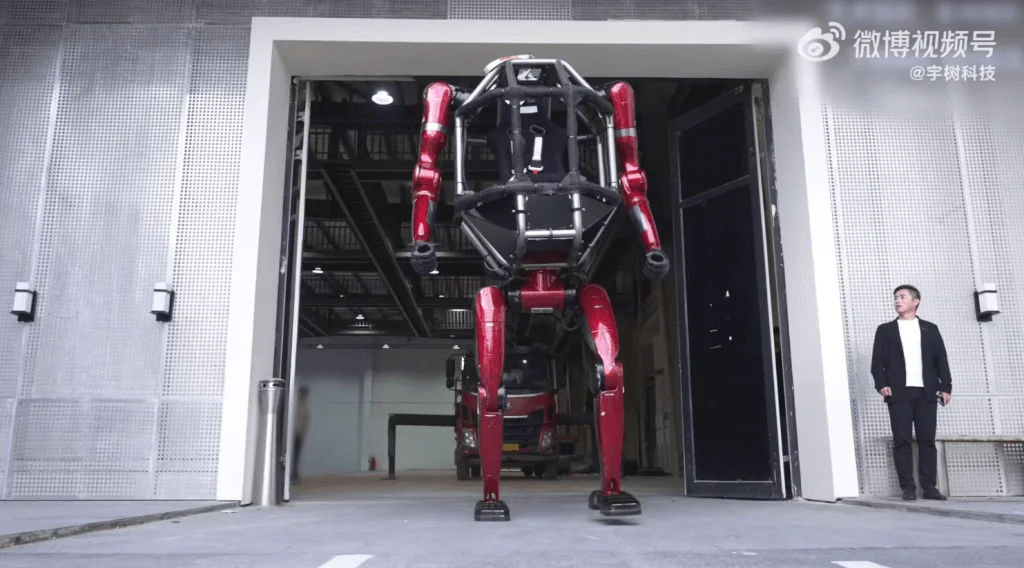
Unitree Robotics is making waves in the robotics arena again, this time with its GD01 manned mech. Founder and CEO Wang Xingxing recently graced the cover of TIME magazine alongside the groundbreaking machine, which stands an impressive 2.7 meters tall. The headline declared: “The Big Robot Moment,” highlighting the cultural significance of this mechanical innovation.
The GD01 is being touted as the world’s first mass-produced manned mech, weighing in at around half a ton. This machine operates from its cockpit housed in the torso, showcasing groundbreaking mobility—it can walk on two legs or transition to four-legged movement. Its impressive mechanical fists are even capable of breaking through walls, illustrating not just mobility but sheer power.
Unlike Unitree’s previous iterations, which were primarily focused on research and industrial applications, the GD01 is positioned to navigate more complex environments. This reflects a shift in the robotics industry toward creating versatile platforms that can operate in varied scenarios, forsaking the earlier singular-purpose designs.
The reaction from the market upon the GD01's unveiling was near-unanimous disbelief; it feels less like a prosaic product and more like something pulled from science fiction lore. Yet, the real significance lies not just in its aesthetic but its implication for the robotics industry. We're witnessing a transition from competition over the robots themselves to a rivalry rooted in their utility.
In terms of market placement, the GD01 doesn't fit neatly into the traditional roles of consumer or industrial robots. Rather, it's designed as a broad platform meant to investigate future mobility scenarios. With its capacity to switch between bipedal and quadrupedal locomotion, it presents adaptability across diverse terrains and unexpected conditions—a factor that could revolutionize applications in hazardous regions, emergency rescue, inspection, and transportation.
This robotic behemoth is attempting to push boundaries where traditional machines falter, tackling the limitations faced in unstructured environments. As it stands, the GD01 could be deployed in precarious operations, pushing the envelope of what robots can achieve in non-ideal conditions.
China's robotics sector has recently surged, transitioning from basic mobility tests like running and performing somersaults to executing complex maneuvers. This evolution has positioned Unitree at the forefront, fostering its expertise in motion control through products that range from consumer-friendly robotic dogs to humanoid robots in their G1 and H series.
However, raw movement capability alone is becoming inadequate for sustained market leadership. As competition intensifies, the pivotal question is shifting: not just how well can a robot move, but how effectively can it perform meaningful tasks? Modern robots must integrate into logistical frameworks, manufacturing plants, inspection routines, and rescue missions, evolving into intelligent machines that provide tangible economic returns rather than showcasing mere technical prowess.
The GD01 exemplifies this new trajectory in robotic innovation. It merges complicated mechanical components with enhanced mobility and intelligent control systems to broaden the operational scopes where robots can thrive. This shift marks a significant departure from previous contests focused solely on hardware specifications, like joint count and speed. The future will be determined more by a robot's cognitive abilities—its capacity to understand surroundings, execute directives, and utilize AI effectively.
While the GD01 may not be the top-selling robot, it could serve as a crucial case study in understanding the direction of China's robotics landscape. Its emergence signals more than a mere product launch; it illustrates a wider industry movement that aims to transfer robots from the confines of laboratories into practical, everyday environments.
Yet, before mainstream adoption can occur, substantial hurdles have to be addressed—issues such as cost limitations, safety standards, battery longevity, and the overall readiness of commercial applications demand attention. Key industry challenges include decreasing production costs, generating actionable data through prolonged usage, and establishing comprehensive safety protocols.
In the near future, sectors like industrial manufacturing and specialized operations in hazardous settings are likely to be the most viable for robotic implementation. One fact, however, is undeniable: the competitive dynamics of the robotics field have unmistakably evolved.
The past decade has revolved around one core concern: how do we make robots move? As we look ahead, the pressing question will be: how do we ensure robots generate substantial value for businesses and society alike?
Discussion
Sign in to join the discussion.