DJI's new EV50 cargo drone sets an altitude record and is designed for diverse applications in challenging environments, enhancing aerial logistics.
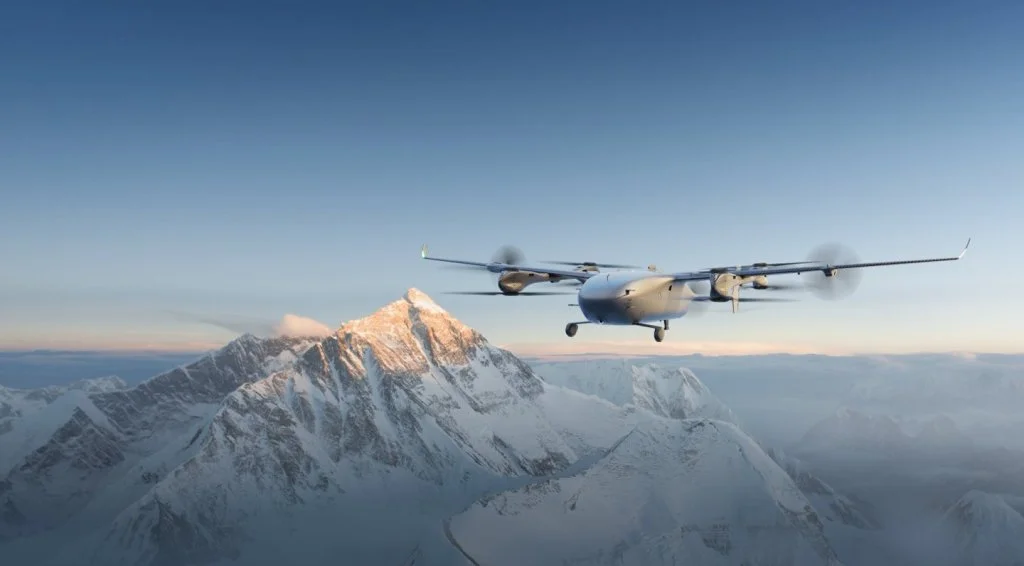
Introduction of the DJI EV50
DJI has launched the EV50, marking a significant step in fixed-wing cargo drones. This vertical takeoff and landing (VTOL) drone is engineered for long-distance regional transport, showcasing its capabilities in rugged and remote environments.
As the commercial drone market has matured, the shift towards specialized applications like cargo transport is becoming increasingly evident. DJI's entry into this market with the EV50 signals the growing recognition of drones as indispensable tools for diverse sectors, from logistics to emergency response. This particular model's VTOL design combines the advantages of both drone maneuverability and airplane efficiency, making it suitable for a wider range of terrains, especially in challenging geographical regions.
Record-Setting Altitude Achievement
The EV50 set a new record by reaching an operational altitude of 8,861 meters during a scientific expedition on Mount Everest, surpassing the summit height by 12 meters. This feat highlights the drone's potential for high-altitude flights previously deemed challenging.
Altitude records are nothing new in aviation, yet achieving significant heights in unmanned aerial vehicles often comes with its own set of challenges. The fact that the EV50 exceeded Everest's height by a notable margin underscores its engineering prowess and operational reliability. Flying at such elevations requires overcoming thin air density, which can impact both thrust and lift. The successful ascent demonstrates not just the drone's capabilities but also implies potential future applications in areas like atmospheric research, where understanding upper-atmosphere conditions is vital.
Expedition Insights
Over a span of 12 days, the EV50 conducted 32 flights, including 12 specific missions to gather atmospheric monitoring data. Launched from Everest Base Camp, located at 5,200 meters, the drone managed to ascend as much as 3,730 meters in a single journey aimed at critical environmental observations.
This level of operational capacity is noteworthy. The fact that the EV50 could execute multiple flights in a short duration while also tackling data collection adds layers to its utility. Most drones struggle to maintain consistent performance at high altitudes, making any reliable data collection a daunting task. This expedition not only illustrates the drone's endurance but also serves as a pivotal learning opportunity for researchers focused on climate change and ecological studies in extreme environments. If you’re working in this space, the insights gleaned from the EV50 could reshape your understanding of atmospheric shifts in these regions.
Research Collaboration
Leading the expedition, Professor Ye Chunxiang from Peking University emphasized the EV50's role in overcoming technical hurdles associated with high-altitude atmospheric monitoring. Traditional methods have struggled beyond 8,000 meters, and the drone's all-electric propulsion system has proven valuable for analyzing glacier winds and assessing climatic influences in the Qinghai-Tibet Plateau region.
Collaboration with educational institutions like Peking University injects a level of credibility and innovation into the project. In many scientific fields, tackling the unknown often requires a partnership between technology developers and researchers. Professor Ye’s insights on the limitations of past methods highlight a clear need for new technological solutions. The EV50 is filling that gap by providing precision and reliability in data collection, thus enabling a better understanding of how climatic changes are impacting fragile ecosystems in the Himalayas.
Technical Specifications
The EV50 boasts a hybrid propulsion mechanism that utilizes eight vertical-lift rotors alongside three fixed-wing motors. It features a maximum payload capacity of 50 kilograms, a range of 150 kilometers without cargo, and a top speed of 160 km/h, all within a spacious 270-liter cargo compartment. Notably, it is designed to operate without the need for a runway, enhancing its utility for diverse operations.
With these specifications, the EV50 positions itself as a versatile player in the cargo drone sector. Its hybrid design not only allows for vertical takeoffs—ideal for tight spaces—but also provides the efficiency of fixed-wing flight for longer distances. This characteristic is particularly relevant in remote areas where infrastructure is lacking. And let’s face it, the ability to carry significant payloads makes it appealing for a variety of applications, from delivering medical supplies in emergencies to transporting scientific instruments for research missions.
Enhanced Operational Features
This drone is equipped with dual thermal management systems, an anti-icing pitot tube, and four independent batteries, ensuring reliability even in adverse conditions. Additionally, an emergency parachute contributes to operational safety standards.
These operational features aren't just bells and whistles; they reflect careful consideration of the environments the EV50 might encounter. Dual thermal management helps maintain optimal performance, which is crucial for flights in extreme weather. The anti-icing pitot tube addresses one of the more dangerous challenges of high-altitude flights—it’s fairly common for drones to lose functionality when ice builds up on critical systems. That said, these safety measures highlight DJI's commitment to responsible drone operation.
Broader Applications
DJI anticipates deploying the EV50 in various fields, including emergency response, logistical operations in isolated areas, and scientific research. The launch of the EV50 builds upon the company’s previous engagements in aerial logistics, notably the FlyCart 30's pioneering drone delivery trials on Everest that provided crucial supplies while also managing waste removal.
Broadening the utility of drones beyond commercial delivery offers a glimpse into their transformative potential across multiple sectors. For example, the EV50 could be invaluable in search-and-rescue operations where conventional transport options may be limited or delayed. In scientific research, it unlocks new capabilities like point data collection in places that are otherwise unreachable. The EV50 is a harbinger of how future drones might integrate into societal frameworks, adapting to varied tasks as demands shift.
Implications and Future Outlook
The introduction of the EV50 isn't merely a milestone for DJI; it signals a larger trend toward sophisticated, specialized drone applications. As industries look for more efficient ways to operate, the capabilities that the EV50 offers may eventually set a standard that competing manufacturers will strive to meet.
What this means for you—whether you're an end-user in logistics, emergency services, or research—is that the paradigm of drone utility is evolving quickly. As these machines become more advanced, they could dramatically reshape how we approach challenging tasks in the sky. If this record-setting altitude is just the starting point, what other capabilities might appear in the near future?
Discussion
Sign in to join the discussion.