MWC Shanghai showcases humanoid robots in an autonomous football penalty shootout, revealing significant advancements and challenges in embodied AI.
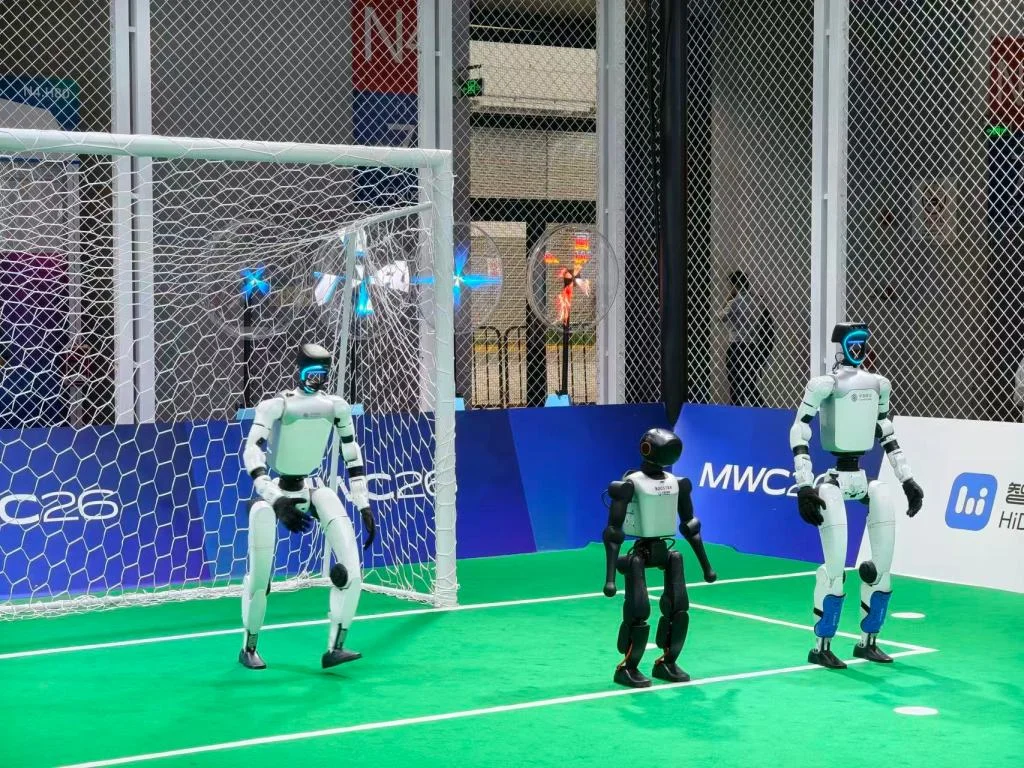
MWC Shanghai 2026 attracted significant attention with a unique spectacle: an autonomous humanoid robot penalty shootout, shifting the focus from typical tech showcases like smartphone launches.
The Setting: A New Type of Competition
Spanning two bustling days at the Shanghai New International Expo Centre, the event captivated an audience of more than 10,000. Eight Chinese teams competed in nearly 100 rounds of penalty kicks, showcasing the innovation bubbling up in China's humanoid robotics sector. Notable participants included China Mobile (Hangzhou) Information Technology, Tianshu Tanjie (Beijing) Technology, and Hangzhou Xingshu Intelligent Robot. The atmosphere was electric, drawing in enthusiasts from various disciplines, transcending traditional tech boundaries and introducing a playful, yet serious evaluation of robotic capabilities.
Excitement in Imperfection
Despite numerous missed shots, the rare successful goals elicited real excitement from spectators. This underscored the thrilling nature of the competition. What stood out was each robot's ability to challenge itself autonomously: locating the ball, positioning itself, executing shots, defending, and regaining balance—all without any human intervention or scripted movements. You couldn't help but feel the tension in the air as robots stumbled, regained their footing, and made genuine attempts to score. This unpredictability added a layer of excitement not found in more controlled tech demonstrations.
Performance Variability and Competitive Edge
The variation in performances highlighted the competitive dynamics among teams. China Mobile’s entry excelled due to its reliable consistency, managing to handle multiple rounds with minimal vision failures or stability disruptions. Engineers credited its performance to a combination of low-latency 5G connectivity and edge AI computations, illustrating how advancements in communication technology are increasingly intertwined with robotics. This isn’t just about faster speeds but about creating real-time responsiveness that can drastically increase efficiency in various applications.
In second place, Tianshu Tanjie’s robot demonstrated impressive motion control. It showcased an ability to adjust its stance and respond effectively to incoming shots from diverse angles—a skill crucial for any adaptable robotic system. This capability is tied to the team's expertise in areas like servo control and dynamic balancing, which are pivotal in robotic design. The nuances in robotic movement aren’t just technical specs; they represent the fine line between success and failure in live environments.
The third-place winner, Hangzhou Xingshu, brought a fresh approach with a lighter build—roughly 30% less weight than competitors—significantly enhancing its agility in movement. While it faced sporadic movement errors, the robot’s overall performance was commendable, indicating a strong start for this newer team. This underpins a trend in robotics toward more nimble designs that can adapt quickly, a characteristic that could define future generations of higher-performing robots in various fields.
The Humor of Imperfection
Attendees humorously noted that the robots performed worse than elementary school children, which, when examined closely, held some truth. Yet the intent of the competition wasn’t to showcase athletic prowess but to assess the robots’ decision-making capabilities amid unpredictable scenarios rather than simply relying on rehearsed routines. This brings us to an interesting point: What we often overlook in the pursuit of flawless performance is the human-like quality of making mistakes and learning from them. This competition illuminated how instances of failure can lead to significant learning opportunities for both robots and their developers.
A Real-World Test of Robotics
The unpredictable environments posed challenges that a controlled lab setting simply wouldn't replicate. It required robots to actively perceive, plan, and adjust in real time—all vital skills for future developments in humanoid robotics. This interaction between machine and environment is crucial for building robots that can function in everyday life. The stark contrast between lab-based evaluations and real-world application highlights a crucial point: testing in artificial settings often fails to predict how systems will behave in uncontrolled situations.
The State of Embodied AI
By opting for a live-action format instead of polished demonstrations, the event laid bare the current state of embodied AI. There's progress, but let's be realistic: we're still a considerable distance from achieving robots that can serve as daily household assistants. And yet, the strides made in recent years are becoming increasingly pronounced. This pushes the dialogue forward about humanoid robots and their potential roles in various sectors, from healthcare to logistics.
Implications and Future Outlook
So, what does all this mean for you if you're working in this space? The implications for robotics are broad. As teams like these refine their technologies, we can expect an influx of more capable robots entering our lives, whether for personal assistance, therapy, or even entertainment. That said, challenges remain. Until we see reliable real-world applications that can outperform traditional systems, skepticism will linger. It seems these competitions are not merely tests of robots but also of our patience with technology that’s on the cusp of delivering real-world benefits.
Discussion
Sign in to join the discussion.